


Did you know a well-chosen commercial espresso machine can produce up to 200 shots daily with remarkable consistency? For cafes, restaurants, and offices, the right equipment means faster service, steady quality, and happier customers. With so many types and features available, understanding these powerful machines makes all the difference in creating drinks that stand out and keeping your business running smoothly.
Table of Contents
- Defining Commercial Espresso Machines and Their Purpose
- Types of Commercial Espresso Machines Explained
- Key Features and How They Work
- Benefits for Cafes, Restaurants, and Offices
- Choosing, Maintaining, and Upgrading Your Machine
Key Takeaways
| Point | Details |
|---|---|
| Purpose of Machines | Commercial espresso machines deliver high-quality, consistent espresso in demanding environments. |
| Types and Features | They are categorized into manual, semi-automatic, automatic, and super-automatic machines, each tailored to specific user needs and operational settings. |
| Business Benefits | Investing in these machines enhances customer satisfaction and operational efficiency, leading to potential revenue growth. |
| Maintenance Importance | Regular maintenance is essential for performance longevity, requiring tasks such as cleaning and descaling. |
Defining Commercial Espresso Machines and Their Purpose
Commercial espresso machines are specialized high-performance brewing appliances engineered to produce consistent, high-volume espresso in professional settings like cafes, restaurants, and coffee shops. According to New York Office of General Services, these machines are designed to heat water and brew espresso coffee through high-pressure steam, catering specifically to high-demand commercial environments.
Commercial espresso machines differentiate themselves from home models through several critical characteristics:
- Robust construction with industrial-grade materials
- Ability to produce 50-200 shots of espresso per day
- Enhanced water heating and pressure systems
- Larger boiler capacities
- More durable internal components
- Faster brewing cycles
The primary purpose of these machines extends beyond merely brewing coffee. They are engineered to deliver consistent quality and rapid service in environments where coffee preparation is a core business function. As Energy Star highlights, modern commercial espresso machines also prioritize energy efficiency, with certified models offering improved performance while reducing operational costs.
Professional baristas and business owners rely on these machines not just for their technical capabilities, but for their ability to transform coffee preparation into a precise, repeatable process.
 Whether in a busy urban cafe or a high-end restaurant, commercial espresso machines represent the intersection of culinary art and engineering precision.
Types of Commercial Espresso Machines Explained
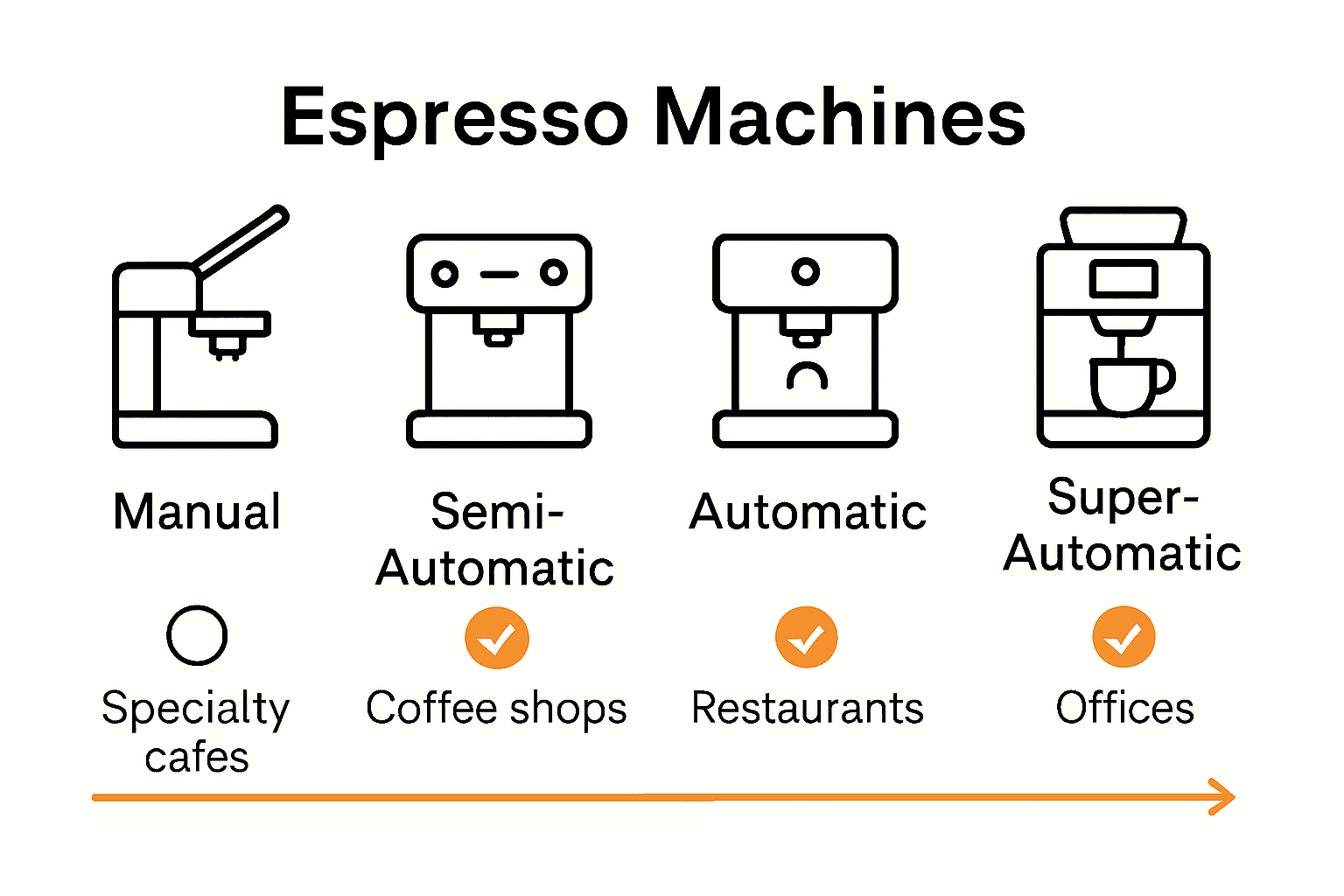
Commercial espresso machines represent a sophisticated spectrum of brewing technologies, each designed to meet specific operational demands. According to About Coffee, these machines are fundamentally categorized into four primary types: manual, semi-automatic, automatic, and super-automatic, offering varying levels of user control and automation.
Operational Control Categories:
- Manual Machines: Complete user control, requiring significant skill
- Semi-Automatic Machines: Partial automation with user-controlled extraction
- Automatic Machines: Programmed shot volumes with consistent brewing
- Super-Automatic Machines: End-to-end brewing process with minimal intervention
From a technical perspective, Texas 4-H further classifies machines by their heating mechanisms, which critically impact brewing performance. These technical classifications include:
- Single Boiler Systems: Basic, cost-effective design
- Heat Exchanger Systems: Improved temperature management
- Thermoblock Systems: Rapid heating technology
- Dual Boiler Systems: Separate boilers for brewing and steaming, offering professional-grade precision
Each machine type serves a unique purpose, from small cafes requiring versatile equipment to high-volume restaurants demanding consistent, rapid espresso production. The choice depends on operational scale, budget, technical expertise, and desired level of brewing control.
Here’s a comparison of the main types of commercial espresso machines:
| Type | User Control | Automation Level | Typical Users |
|---|---|---|---|
| Manual | Full control | None | Skilled baristas |
| Semi-Automatic | User-controlled | Partial | Cafes, small restaurants |
| Automatic | Programmable shots | High | Busy cafes, offices |
| Super-Automatic | Minimal control | Full | High-volume businesses |
Key Features and How They Work
Commercial espresso machines are complex engineering marvels that transform simple water and coffee grounds into precision-crafted espresso. According to ASME, these machines rely on intricate components like pumps, boilers, and portafilters working in concert to force water through coffee grounds at high pressure, creating the characteristic intense espresso extraction.
Core Functional Components:
- Pump System: Generates consistent high-pressure water flow
- Boiler: Maintains precise water temperature
- Portafilter: Holds ground coffee during extraction
- Group Head: Connects portafilter to machine, distributes water
- Steam Wand: Creates microfoam for milk-based drinks
About Coffee highlights that essential features like pressure control, steam wand performance, and programmable settings are critical to consistent espresso production. Professional machines typically operate at 9-10 bars of pressure, which is the sweet spot for extracting maximum flavor without bitterness.
Modern commercial espresso machines integrate sophisticated technology to ensure repeatable quality. The extraction process involves multiple precise steps: coffee grinding, tamping, water heating, pressure generation, and precise timing. This complex choreography transforms raw ingredients into a perfect espresso shot, making these machines not just appliances, but true culinary precision instruments. For enthusiasts looking to dive deeper into machine mechanics, our dual boiler system guide offers an in-depth exploration of advanced brewing technologies.
Benefits for Cafes, Restaurants, and Offices
Commercial espresso machines are strategic investments that transform beverage service across multiple business environments. According to About Coffee, these machines enable establishments to offer a variety of high-quality coffee beverages, directly enhancing customer satisfaction and potentially increasing revenue through diversified menu offerings.
Key Business Advantages:
- Rapid beverage preparation
- Consistent drink quality
- Professional presentation
- Expanded menu possibilities
- Increased customer perception of service quality
Energy Star provides a compelling economic perspective, revealing that certified commercial coffee brewers are 27% more energy-efficient than standard models, potentially saving businesses approximately $180 over the machine’s lifetime. This efficiency translates to significant operational cost reductions while maintaining high-performance standards.
Beyond financial considerations, these machines offer operational flexibility across different commercial settings. In cafes, they enable baristas to craft intricate espresso-based drinks quickly. Restaurants can elevate their beverage service, while offices can provide professional-grade coffee experiences that boost employee morale and productivity. For those seeking deeper insights into advanced brewing technologies, our dual boiler system guide explores the sophisticated mechanics behind these remarkable machines.
Choosing, Maintaining, and Upgrading Your Machine
Selecting the perfect commercial espresso machine requires careful consideration of multiple factors. According to Texas 4-H, the selection process involves evaluating budget constraints, desired drink types, and specific machine features that align with your operational needs.
Key Selection Criteria:
- Production volume requirements
- Available budget
- Types of beverages offered
- Space limitations
- Technical complexity tolerance
- Maintenance accessibility
ASME emphasizes that upgrading to modern machines with advanced technologies can significantly improve energy efficiency, precision, and overall user experience. These technological enhancements not only benefit baristas but also elevate customer satisfaction through consistently high-quality beverages.
Maintenance is equally critical for long-term performance. Regular cleaning, descaling, and preventative maintenance practices will extend your machine’s lifespan and ensure optimal brewing conditions. Think of your espresso machine like a high-performance vehicle – consistent care prevents costly breakdowns and maintains peak operational efficiency. Investing time in routine maintenance is far more economical than facing unexpected repairs or premature machine replacement.
Elevate Your Commercial Espresso Machine Performance Today
Running a successful cafe or restaurant means delivering consistent, high-quality espresso with every shot. If you want to overcome challenges like maintaining perfect water temperature, optimizing pressure, or ensuring rapid beverage preparation, precision parts and expert upgrades are essential. At Coffee Sensor, we specialize in providing professional-grade accessories, from temperature sensors to durable gaskets, designed to boost your espresso machine’s reliability and extraction quality.

Don’t wait until operational hiccups affect your service quality. Explore our curated selection of coffee machine upgrades and parts that help you deliver flawless espresso drinks every time. Visit Coffee Sensor now and take the next step toward maximizing your machine’s performance and delighting your customers.
Frequently Asked Questions
What is a commercial espresso machine?
Commercial espresso machines are high-performance brewing appliances designed to produce consistent, high-volume espresso for professional environments such as cafes and restaurants. They differ from home models through robust construction, enhanced heating systems, and the ability to produce numerous shots per day.
What are the main types of commercial espresso machines?
Commercial espresso machines are generally categorized into four types: manual, semi-automatic, automatic, and super-automatic. Each type offers varying levels of user control and automation, catering to different operational needs and skill levels.
What are the key features to look for in a commercial espresso machine?
Key features to consider include the pump system for consistent high-pressure water flow, boiler for temperature control, portafilter for grounding coffee, group head for water distribution, and steam wand for milk frothing. Also, look for programmable settings and pressure control for better espresso consistency.
How do I maintain my commercial espresso machine?
Regular maintenance includes cleaning, descaling, and following preventative maintenance practices. This helps extend the machine’s lifespan and ensures optimal brewing quality. Proper care is essential to avoid costly repairs and maintain peak performance.


